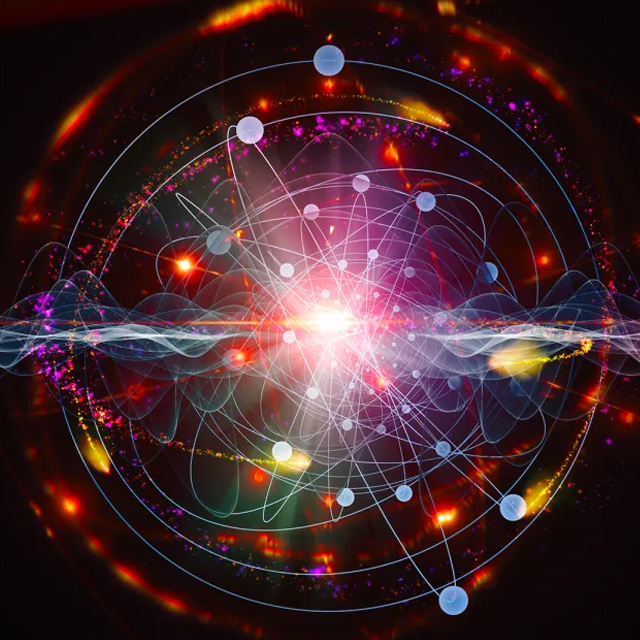
Quantum field theory (QFT) is the most successful and precisely tested framework in all of physics. It describes reality not as composed of tiny billiard-ball particles, but as an interwoven tapestry of quantum fields โ invisible, omnipresent fields of energy that permeate every point in space and time.
Each type of fundamental particle corresponds to its own quantum field: the electron field, the photon field (electromagnetic field), the Higgs field, and so on. What we perceive as "particles" are actually localized vibrations โ excitations โ of these underlying fields. An electron isn't a "thing"; it's a quantized disturbance in the electron field, much like a wave is not separate from the ocean.
The quantum vacuum โ what appears to be empty space โ isn't empty at all. It seethes with virtual particle-antiparticle pairs, constantly appearing and annihilating in timescales of 10โปยฒยน seconds. This "zero-point energy" of the vacuum is estimated to contain more energy per cubic centimeter than all the matter in the observable universe. This is the field you are learning to access through meditation.
The implications for consciousness are profound. If you are made of quantum fields, and those fields extend infinitely, then your physical boundaries are conventions โ useful models, but not fundamental truths. At the deepest level of reality, there is no separation between the meditator and the cosmos.
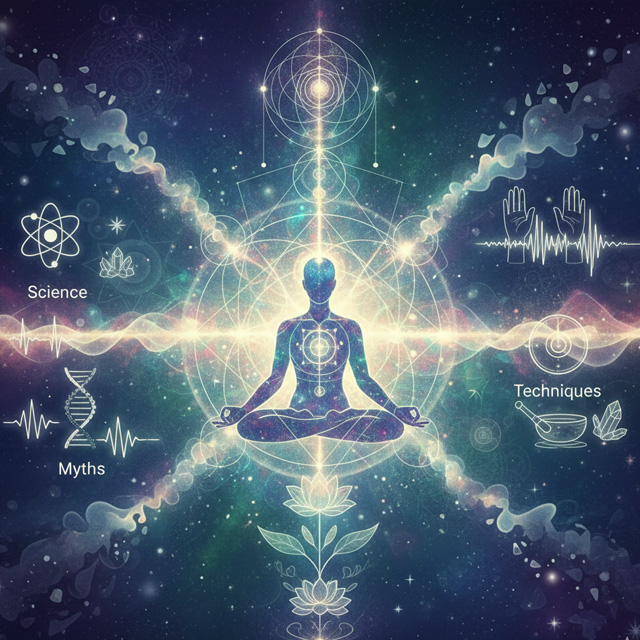
In 1801, Thomas Young's double-slit experiment demonstrated that light behaves as both a wave and a particle. But the truly revolutionary discovery came later: when physicists placed detectors to observe which slit a photon passes through, the wave-like interference pattern collapsed into a particle pattern. The act of observation itself changed the outcome.
This is not metaphor โ it is established, replicated, undeniable experimental physics. The Copenhagen interpretation, championed by Niels Bohr and Werner Heisenberg, states that quantum systems exist in superposition (all possible states simultaneously) until measured. Measurement โ observation โ collapses the wave function into a single definite state.
The philosophical implications have occupied physicists for a century. John Wheeler, Einstein's colleague at Princeton, proposed the "participatory universe" โ the idea that observers are necessary for the universe to exist. Eugene Wigner formally argued that consciousness itself is the collapse mechanism. John von Neumann's mathematical treatment of quantum mechanics reached the same conclusion.
"It was not possible to formulate the laws of quantum mechanics in a fully consistent way without reference to consciousness." โ Eugene Wigner, Nobel Laureate in Physics
For meditation practitioners, the observer effect provides a scientific framework for understanding how focused attention influences reality. When you enter deep meditation and hold a clear intention, you are functioning as a quantum observer โ selecting from the infinite field of possibilities the specific reality you wish to manifest.
The delayed-choice quantum eraser experiment (Kim et al., 1999) added another layer: the decision to observe or not observe can retroactively change the behavior of photons after they've already been detected. This suggests that consciousness may not be bound by linear time โ a finding consistent with the non-temporal experiences reported by advanced meditators across traditions.
Decades of neuroimaging research reveal that meditation physically restructures the brain and alters its electromagnetic output.
Beta (13โ30 Hz): Normal waking consciousness, analytical thinking, stress response. Most people spend their entire waking lives here, trapped in repetitive thought loops controlled by the default mode network.
Alpha (8โ13 Hz): Relaxed awareness, the bridge between conscious and subconscious. Meditation begins here. Alpha waves increase serotonin production and reduce cortisol, creating the biochemistry of calm alertness.
Theta (4โ8 Hz): Deep meditation, hypnagogic state, access to subconscious programming. In theta, the critical factor of the conscious mind relaxes, allowing direct reprogramming of deeply held beliefs and emotional patterns.
Delta (0.5โ4 Hz): Typically associated with deep sleep, but advanced meditators access delta while remaining conscious. In this state, growth hormone production increases by up to 200%, and the body enters its deepest healing and regeneration cycle.
Gamma (30โ100+ Hz): The signature of heightened consciousness. Gamma waves indicate cross-cortical synchronization โ the entire brain firing in unison. Tibetan monks produce sustained gamma at levels 25x above baseline. Gamma correlates with states of insight, compassion, and transcendence.
Prefrontal Cortex: Harvard neurologist Sara Lazar's 2005 study showed that meditators had increased cortical thickness in the prefrontal cortex โ the region responsible for executive function, decision-making, and emotional regulation โ even in participants over 50, countering the normal age-related thinning.
Amygdala: The brain's fear center shows decreased gray matter density after just 8 weeks of mindfulness-based stress reduction (MBSR). Simultaneously, connectivity between the amygdala and prefrontal cortex strengthens, meaning the "thinking brain" gains greater influence over the "reactive brain."
Default Mode Network: Meditation reduces activity in the DMN โ the neural network active during mind-wandering, self-referential thought, and rumination. Overactive DMN is correlated with anxiety, depression, and ADHD. Experienced meditators show DMN deactivation comparable to the effects of psilocybin, without any pharmacological intervention.
Hippocampus: Increased gray matter in the hippocampus (memory formation and learning) has been demonstrated in multiple studies. This is particularly significant because the hippocampus is one of the first structures damaged in Alzheimer's disease, suggesting meditation may have neuroprotective effects.
Corpus Callosum: Long-term meditators show enhanced connections through the corpus callosum, the bridge between left and right brain hemispheres, promoting the whole-brain integration associated with creativity, intuition, and expanded awareness.
The heart is not merely a mechanical pump. It contains approximately 40,000 neurons โ its own intrinsic nervous system, sometimes called the "heart brain." The heart sends more information to the brain than the brain sends to the heart, via the vagus nerve, hormonal signals, pressure waves, and its powerful electromagnetic field.
The heart's electromagnetic field is approximately 5,000 times stronger than the brain's, measurable by magnetometers (SQUID devices) at distances of several feet from the body. When heart rhythms enter a coherent pattern โ characterized by smooth, sine-wave-like HRV patterns โ this field becomes organized and expansive.
HeartMath Institute research has demonstrated remarkable findings: when two people are in close proximity and one enters heart coherence, the coherent individual's heartbeat becomes detectable in the other person's brain wave recordings (EEG). The heart's coherent field literally influences the neural activity of nearby individuals.
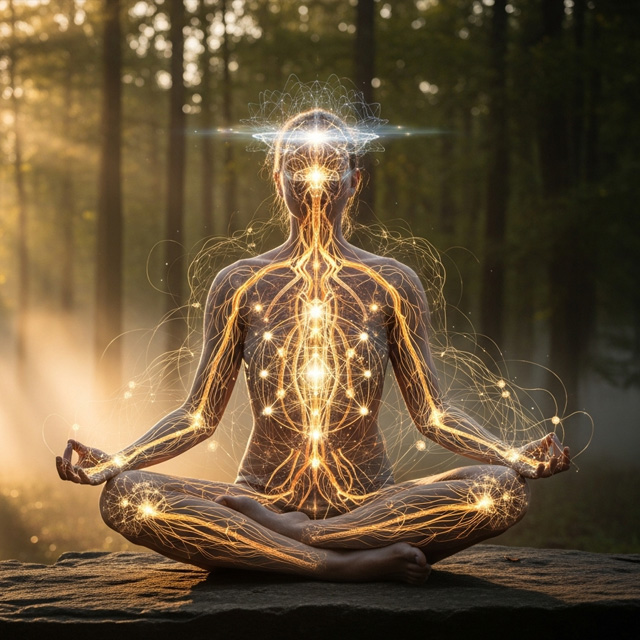
During quantum field meditation, practitioners intentionally cultivate heart coherence through breath regulation (approximately 6 breaths per minute), elevated emotional states (gratitude, compassion, love), and focused attention on the heart center. This creates a measurable electromagnetic environment that quantum physics suggests may influence probability distributions in the local quantum field.
The implications are staggering: your emotional state isn't private โ it's broadcast electromagnetically into your environment, influencing the biology of others. Heart coherence meditation may be the mechanism behind what spiritual traditions have called "the power of prayer," "healing presence," and "spiritual transmission."
The old genetic paradigm โ that DNA is a fixed blueprint determining your biology, health, and lifespan โ has been overturned by the science of epigenetics. Dr. Bruce Lipton's groundbreaking work demonstrated that the environment around your cells, not the DNA within them, controls gene expression.
Meditation directly influences this cellular environment. When you meditate, you reduce cortisol and inflammatory cytokines while increasing DHEA, serotonin, melatonin, and growth hormone. These biochemical changes alter the epigenetic marks (methylation patterns and histone modifications) that determine which genes are activated and which are silenced.
A landmark 2013 study published in PLOS ONE by researchers from the University of Wisconsin-Madison found that a single day of intensive meditation practice resulted in measurable changes in the expression of genes involved in:
This means that every meditation session is a conversation with your DNA โ a direct neurochemical message to your 37.2 trillion cells that shifts the trajectory of your biological expression. You are, quite literally, becoming a new person at the molecular level.
Exploring the deepest questions in science and philosophy: What is consciousness? How does subjective experience arise? And what role does the quantum field play?
The mainstream neuroscience view holds that consciousness emerges from sufficiently complex neural processing โ that subjective experience is what brain computation "feels like" from the inside. This position, while scientifically productive, faces the "hard problem" identified by philosopher David Chalmers: no amount of describing neural correlates explains why there is subjective experience at all. Why isn't the brain just a biological computer processing information "in the dark," without any inner experience? This explanatory gap remains the greatest unsolved problem in science.
Sir Roger Penrose (Nobel Prize in Physics, 2020) and Stuart Hameroff proposed that consciousness arises from quantum computations occurring within microtubules โ protein structures inside neurons. Their Orchestrated Objective Reduction (Orch OR) theory suggests that quantum superpositions in microtubules collapse due to quantum gravity effects, and each collapse event is a moment of conscious experience. Recent experimental evidence by Anirban Bandyopadhyay at NIMS Japan has provided support for quantum vibrations in microtubules, lending credibility to this once-controversial theory.
An increasingly respected position in philosophy of mind, panpsychism holds that consciousness is not produced by matter but is a fundamental feature of reality โ as basic as mass, charge, or spin. Max Planck stated: "I regard consciousness as fundamental. I regard matter as derivative from consciousness." This view is gaining support from philosophers like Philip Goff and neuroscientist Giulio Tononi, whose Integrated Information Theory (IIT) provides a mathematical framework suggesting that any system with sufficient integrated information possesses some degree of consciousness.
Physicist David Bohm proposed that beneath the "explicate order" of manifest reality lies an "implicate order" โ an enfolded wholeness where everything is interconnected. In Bohm's framework, the universe is like a hologram โ every part contains information about the whole. Consciousness, in this view, is not localized in brains but is a property of the implicate order itself, manifesting through brains as the implicate unfolds into the explicate. This provides a rigorous physical framework for understanding the non-local awareness reported by meditators โ the sense of accessing information beyond personal memory and perceiving an underlying unity.
The Advaita Vedanta tradition, codified by Adi Shankara in the 8th century CE (building on the Upanishads dating to 800โ200 BCE), describes consciousness (Brahman) as the sole reality โ infinite, eternal, and beyond all attributes. The physical world (Maya) is not illusion in the sense of being fake, but rather a partial perception of Brahman through the limited lens of individual mind. This framework, remarkably, mirrors the quantum mechanical view that localized particles are partial manifestations of underlying fields. When a meditator experiences Samadhi โ the dissolution of subject-object duality โ they may be directly experiencing the quantum field's unified nature.
The emerging field that may explain how consciousness interacts with matter at the biological level.
Plants achieve near-100% efficiency in energy transfer during photosynthesis by using quantum coherence โ multiple energy pathways existing simultaneously until the optimal route is "selected." If nature uses quantum effects in biology, human neural processes may do the same.
European robins navigate using quantum entanglement in cryptochrome proteins in their retinas. Pairs of electrons become quantum-entangled, and the Earth's magnetic field influences their spin states, creating a "quantum compass." This proves quantum effects operate at biological temperatures.
Enzymes speed up biochemical reactions by factors of millions. Research suggests they achieve this through quantum tunneling โ particles passing through energy barriers that classical physics says are impassable. Your body performs quantum mechanics trillions of times per second.
Luca Turin's quantum theory of smell proposes that our olfactory receptors detect molecular vibrations through quantum tunneling, not just molecular shape. This means our sensory experience of the world may be quantum-mediated at a fundamental level.
Proton tunneling in DNA base pairs may be a primary mechanism of genetic mutation. The quantum behavior of hydrogen bonds in DNA means that the evolution of life itself โ the engine of biological diversity โ operates through quantum mechanical processes.
Anirban Bandyopadhyay's research has detected quantum vibrations in microtubules at megahertz frequencies โ far faster than the ~100 Hz frequency of neural firing. If consciousness operates through microtubule quantum states, meditation may enhance quantum coherence in neural microtubules.
Understanding the science is the first step. Experiencing the quantum field is the transformation. Discover the techniques that bridge knowledge and practice.