The environment in which you meditate directly influences the quality of your practice. Research in environmental psychology shows that physical spaces shape neural activity โ a cluttered room activates the brain's attention-competition circuits, while a serene space reduces cortisol and allows the parasympathetic nervous system to engage more quickly.
Physical Space: Choose a quiet, clean area where you won't be disturbed. Temperature should be comfortable (slightly cool is optimal โ 65-68ยฐF / 18-20ยฐC โ as a mild cool stimulus promotes alertness while the body naturally warms during deep meditation). Dim lighting or candlelight triggers melatonin production, helping the brain shift from beta to alpha waves.
Time Selection: The hours of 4-6 AM (Brahma Muhurta in Vedic tradition) correspond to a natural nadir in cortisol and a peak in melatonin โ your biology is already primed for meditative states. If this isn't practical, early morning or late evening are optimal. Consistency matters more than duration: 20 minutes daily rewires the brain faster than sporadic 2-hour sessions.
Body Preparation: Avoid eating for 90 minutes before practice โ digestion diverts blood flow from the brain. Light stretching or yoga prepares the musculoskeletal system for stillness. Empty your bladder. Wear loose clothing. These seem like minor details, but they eliminate the micro-distractions that prevent the deep surrender necessary for quantum field access.
Digital Boundary: Silence all devices. Even a phone on vibrate generates an electromagnetic field that research suggests may interfere with the brain's own delicate electromagnetic emissions during meditation. Airplane mode is recommended. The practice of creating a tech-free zone is itself a form of mental training โ rehearsing the discipline of choosing awareness over stimulation.
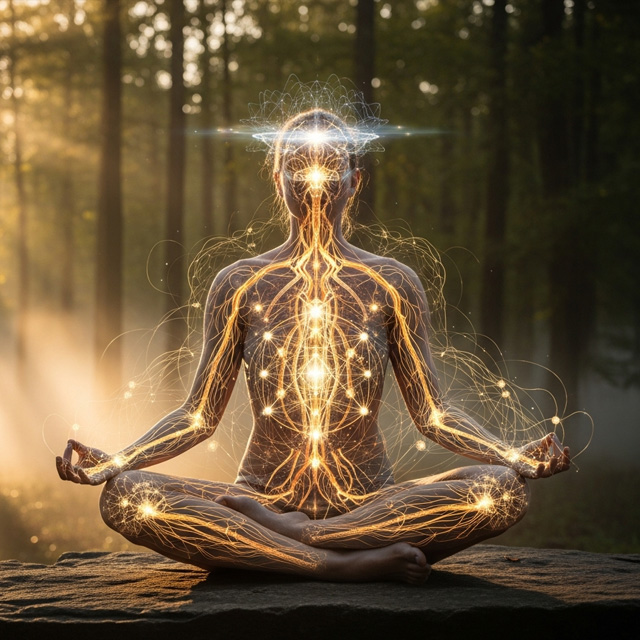
A 21-day foundational program designed to establish the neural pathways, breathing patterns, and awareness skills necessary for deeper quantum field work.
Duration: 10-15 minutes daily
Focus: Simply observing the breath without trying to change it. This develops the witness consciousness โ the ability to observe internal experience without reacting. Neuroscientifically, this strengthens prefrontal cortex connections to the amygdala, building the neural circuitry of emotional regulation.
Practice: Sit comfortably. Close your eyes. Notice the sensation of air entering and leaving your nostrils. When thoughts arise (and they will โ approximately 6-8 thoughts per minute is normal), simply notice them without judgment and return attention to the breath. Each return is a "rep" โ like a bicep curl for the attention muscle. You are literally building neural density in the anterior cingulate cortex, the brain's attention hub.
Common Experience: Restlessness, boredom, frustration, sleepiness. These are not failures โ they are the symptoms of a brain accustomed to constant stimulation encountering stillness for the first time. By Day 5-7, most practitioners report noticeably increased calm and a beginning sense of "the observer" โ awareness watching thoughts rather than being consumed by them.
Duration: 15-20 minutes daily
Focus: Developing interoception โ internal body awareness. The insula cortex processes interoceptive signals, and its thickness correlates with emotional intelligence, empathy, and meditative depth. This week strengthens that neural structure.
Practice: After 3 minutes of breath awareness, systematically move attention through the body โ from the crown of the head, through the face, neck, shoulders, arms, hands, chest, abdomen, pelvis, legs, and feet. At each area, simply notice sensations without labeling them as good or bad. After completing the scan, sit with awareness of the entire body as a unified field of sensation.
Common Experience: Tingling, warmth, pulsing, or subtle electrical sensations as attention moves through the body. These are not imaginary โ they reflect increased blood flow and neural activity in the attended areas. Some practitioners report detecting their heartbeat throughout the body, a sign of enhanced interoceptive sensitivity.
Duration: 20 minutes daily
Focus: Integrating breath awareness and body awareness with heart-centered emotion. This week introduces the core practice of Quantum Field Meditation โ heart-brain coherence โ at a beginner-appropriate pace.
Practice: Begin with 3 minutes of breath observation, then 5 minutes of body scanning. Once the body is relaxed and awareness is stable, shift focus to the heart center. Begin coherence breathing (5-seconds in, 5-seconds out). On each inhale, breathe in the feeling of appreciation; on each exhale, radiate that feeling outward. Maintain for 10-12 minutes.
Common Experience: Warmth in the chest area, spontaneous smiling, occasional tears (emotional release), and a sense of expansion beyond the physical body. Some practitioners report their first experience of "the field" โ a sensation of being held in something vast and benevolent. HRV measurements during this phase typically show emerging coherence patterns that will strengthen with continued practice.
Duration: 25-45 minutes daily
Focus: Having established breath awareness, interoceptive sensitivity, and heart coherence, you now have the foundational skills to begin the advanced techniques detailed on our Techniques page.
Research Note: MRI studies show that measurable brain changes begin appearing after approximately 11 hours of total meditation time. At 20 minutes daily, Day 33 marks the statistical threshold where structural brain changes become detectable. The 21-day beginner protocol ensures you arrive at this threshold with clean technique and established neural patterns.
From this point, the quantum field techniques โ visualization, energy body activation, walking meditation, and quantum sleep โ build upon these foundational skills. The journey deepens exponentially from here, as each technique opens new neural pathways that enhance the effectiveness of all other techniques.
For intermediate and advanced practitioners, this daily structure creates a comprehensive field of quantum awareness that permeates the entire day โ not just the meditation session.
Within 30 minutes of waking, before checking devices. The brain naturally resides in alpha-theta upon waking, making this the optimal window for quantum field access. Practice: Coherence Breath โ Heart Coherence โ Quantum Field Visualization โ Intention Setting โ Gratitude Seal.
Between 12-2 PM, when cortisol naturally dips. Close your eyes (or soften your gaze if in public), perform 2 minutes of coherence breathing, and briefly re-establish heart coherence. This prevents the afternoon cortisol crash, resets accumulated stress, and maintains the quantum field awareness established in the morning session.
1-2 hours before sleep. This session focuses on review and integration rather than new intention. Practice: Body scan to release accumulated tension โ Heart coherence โ Mental review of the day from the observer perspective (what patterns arose? what emotional reactions occurred? what triggered them?) โ Gratitude for three specific experiences โ Release into stillness.
In bed, as you feel drowsiness approaching. Practice the Quantum Sleep Protocol: coherence breathing โ single intention or elevated emotion โ maintain awareness across the sleep threshold. This transforms 7-8 hours of sleep into an extended quantum field interaction, leveraging the brain's natural theta-delta oscillations for deep reprogramming.
Every practitioner encounters obstacles. Understanding the neuroscience behind these challenges transforms them from roadblocks into signposts of progress.
The average human has approximately 60,000 thoughts per day, with 95% being repetitive. In meditation, you're not trying to stop thoughts โ you're training the ability to observe them without engaging. The default mode network (DMN) generates this constant stream; it's your brain's "screen saver." Each time you notice you've drifted and return to awareness, you strengthen the anterior cingulate cortex. This is the practice. Thinking is not failure โ noticing that you're thinking is success.
This indicates your body carries significant sleep debt or that you're transitioning too quickly from beta to delta without pausing in the alpha-theta range. Solutions: meditate sitting upright (not lying down), ensure adequate nightly sleep, splash cold water on your face before practice, or practice with eyes slightly open (soft gaze at the floor). As your neural circuitry develops, you'll maintain awareness in progressively deeper states without losing consciousness.
Dramatic experiences are not the goal โ they're occasional side effects. The real transformation happens in the neural restructuring that occurs invisibly, below the threshold of perception. Like exercise, the cellular-level changes precede the visible results by weeks. Trust the process: if you're practicing consistently, your brain is rewiring regardless of subjective experience. EEG studies confirm that brain wave changes begin within sessions, even when the practitioner reports "nothing happened."
This is a sign of deep psychological processing and is entirely normal, particularly in weeks 2-6. Meditation reduces the suppression mechanisms that the default mode network uses to keep unprocessed emotions below conscious awareness. When these emotions surface, they're being released, not created. The practice: observe them without story. Feel the emotion as pure sensation in the body โ where is it? what does it feel like? โ without attaching narrative. This allows the neural pattern to complete its processing cycle and integrate.
Habit formation requires approximately 66 days for complex behaviors (not 21, as commonly claimed โ per research by Phillippa Lally at UCL). Start absurdly small: 3 minutes of breath observation upon waking. Link it to an existing habit (e.g., "after I pour my morning coffee, I breathe for 3 minutes"). This leverages the brain's habit-stacking circuitry in the basal ganglia. Once the 3-minute practice is automatic, extend to 5, then 10, then 20 minutes. Small consistent practice beats ambitious inconsistency every time.
As practice deepens over months and years, practitioners encounter distinct states of consciousness that correspond to measurable changes in brain activity. Recognizing these states helps you navigate the inner landscape with confidence and deepen your practice intentionally.
The Witness State (Alpha-Theta): A stable sense of being the observer of thoughts, emotions, and sensations rather than being identified with them. The content of experience continues, but "you" are the awareness in which it unfolds. Neurologically, this corresponds to decreased DMN activity and increased connectivity between the dorsolateral prefrontal cortex and insula.
The Flow State (Low Beta with Gamma Bursts): Complete absorption in the meditation, where effort dissolves and awareness becomes effortless. Time distortion is common โ a 30-minute session feels like 5 minutes. This state correlates with increased norepinephrine and dopamine, decreased self-referential processing, and transient hypofrontality (temporary quieting of the analytical prefrontal cortex).
The Field State (Sustained Gamma): The boundary between self and environment dissolves. Awareness expands to include the room, the building, the sky, potentially infinity. This corresponds to global gamma synchronization โ the entire brain oscillating in phase at 40+ Hz. This is the state most associated with quantum field access, non-local awareness, and the mystical experiences described across all contemplative traditions.
The Unity State (Gamma with Delta): The rarest and most profound state โ gamma-wave coherence simultaneous with delta-wave amplitude, paradoxically combining the highest frequency of conscious awareness with the deepest frequency of unconscious processing. Practitioners describe this as simultaneously being nothing and everything, nowhere and everywhere. Brain science has no adequate model for this state; it may represent consciousness operating at a quantum level beyond current neuroscience's ability to explain.
Explore real-world case studies of practitioners who have experienced measurable transformation through consistent quantum field meditation practice.